
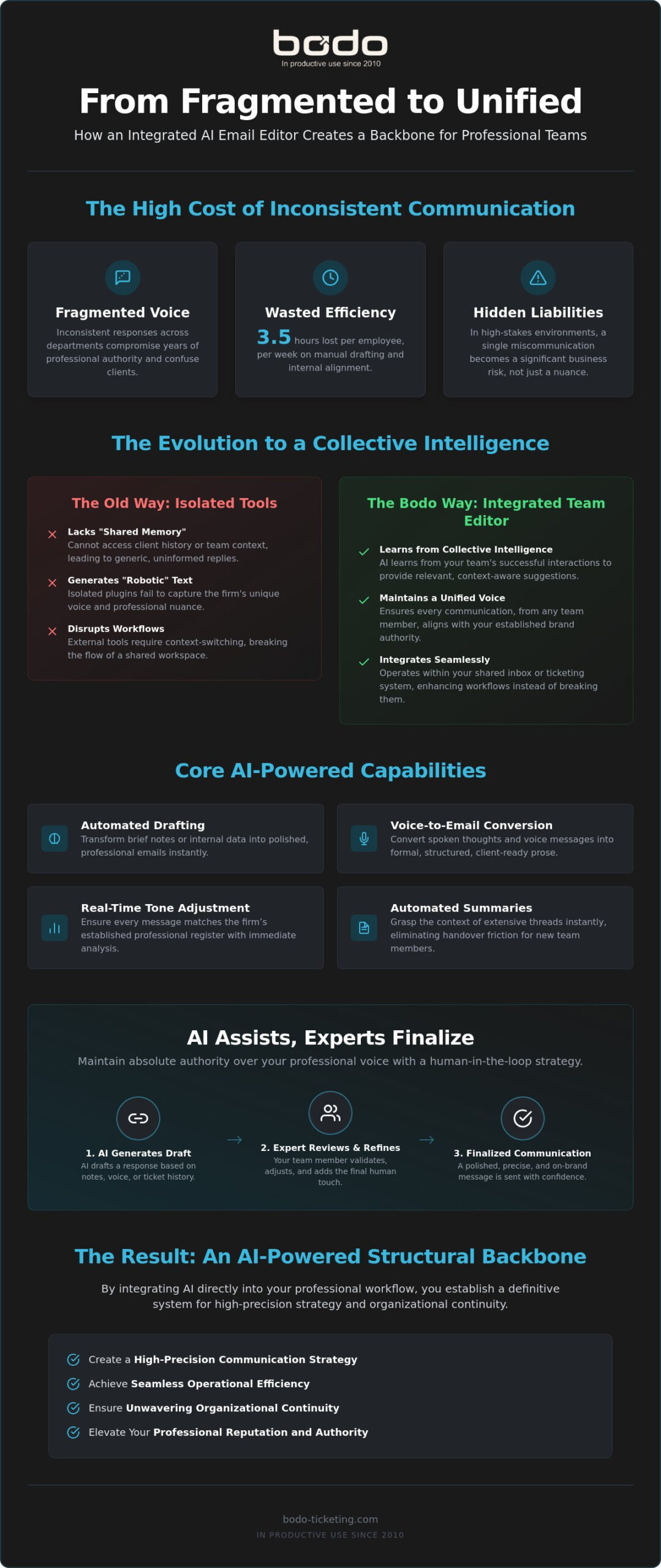
A single inconsistent response can compromise years of established professional authority. In high-stakes environments, the risk of miscommunication isn’t just a nuance. It’s a liability. Many organizations find their collective voice fragmented across various departments, leading to a loss of clarity and an average of 3.5 hours wasted per week on manual drafting. Implementing an AI email editor for teams is no longer about simple automation. It’s about establishing a structural backbone for organizational continuity and professional elevation.
You likely recognize that maintaining a unified voice while scaling operations is a complex administrative challenge. This article demonstrates how AI-powered editing transforms fragmented correspondence into a high-precision communication strategy. We’ll explore the transition toward faster response times and the seamless integration of AI within a shared workspace. This progression ensures your team operates with the reliability and meticulous order that sophisticated professionals demand.
Key Takeaways
- Understand the transition from basic grammar correction to a sophisticated AI email editor for teams that prioritizes professional intent and contextual accuracy.
- Explore methods for converting voice messages into polished drafts and summarizing extensive threads to ensure immediate team synchronization.
- Maintain absolute authority over your professional voice by utilizing a “human-in-the-loop” strategy where AI assists and experts finalize.
- Streamline your operational efficiency by auditing repetitive communication patterns and centralizing data within a unified shared inbox.
- Discover the impact of integrating AI directly into a professional ticketing system to create a definitive structural backbone for your organization.
What is an AI Email Editor for Teams?
An AI email editor for teams is a centralized technological asset designed to assist multiple users in the drafting, refining, and translating of client correspondence. It represents a significant evolution from basic grammar tools. While standard spell-checkers focus on surface-level errors, this system utilizes advanced Natural Language Processing to grasp the nuances of professional intent. It understands context. It recognizes professional standards. It ensures that every response, regardless of who sends it, aligns with the firm’s established reputation for precision.
This technology operates within a shared workspace. It allows an entire organization to adhere to a single, authoritative brand voice. By integrating directly with CRM data, the editor provides contextually relevant suggestions for every ticket. It draws from client history to ensure continuity. This level of structural integrity is essential for specialized industries where accuracy is not optional. It transforms fragmented communication into a methodical, high-precision strategy.
The core functions of team-based AI editors
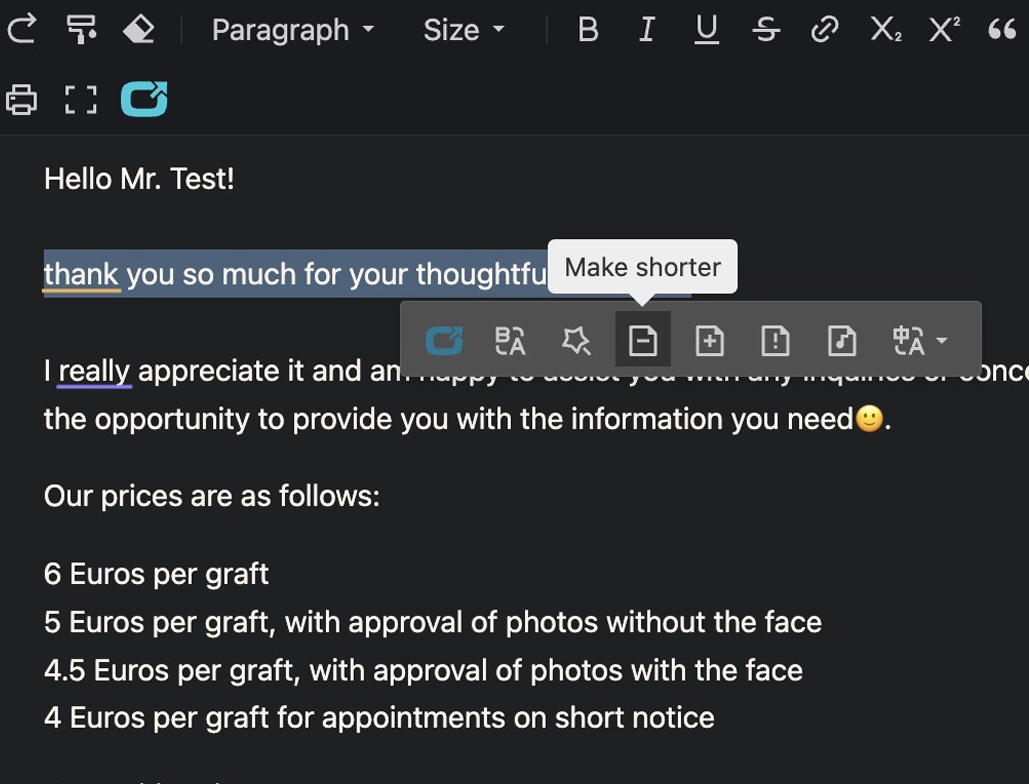
The primary utility of an AI email editor for teams lies in its ability to streamline complex administrative workflows. It doesn’t just suggest words; it builds drafts. Teams can generate comprehensive responses based on brief internal notes or even voice messages. This functionality reduces operational friction significantly. Key features include:
- Automated Drafting: Transform raw data or vocal instructions into polished, professional emails instantly.
- Real-time Tone Adjustment: Ensure every message matches the firm’s established professional register through immediate analysis.
- Technical Translation: Serve a diverse, international client base without losing the technical accuracy required in high-stakes environments.
Individual tools vs. integrated team editors
Many professionals attempt to use browser extensions or standalone writing assistants. These individual tools often fail the needs of a synchronized agency or clinic. They lack “Shared Memory.” An isolated tool cannot understand the history of a specific client relationship or the collective goals of a department. This fragmentation often leads to the “robotic” feel associated with generic AI writing. It lacks the soul of the firm’s history.
Centralized editors solve this problem through total integration. By existing within the team’s shared workspace, the AI learns from the organization’s collective intelligence. It becomes a disciplined strategist that supports the team rather than an external plugin that disrupts the flow. This ensures that every communication feels personal and informed, maintaining the quiet confidence that discerning clients expect from a premium service provider.
Beyond Drafting: How Teams Leverage AI for Unified Communication
A sophisticated AI email editor for teams serves as more than a digital scribe. It functions as a structural backbone that ensures organizational continuity. While individual drafting tools focus on the output of a single user, a team-oriented system prioritizes the collective intelligence of the entire firm. This shift from individual productivity to team-wide synchronization is supported by an academic study on AI in organizational communication, which suggests that AI integration significantly enhances message acceptance and employee performance. By centralizing communication, firms can eliminate the fragmentation that typically plagues high-stakes professional environments.
The power of automated email summaries
Handover friction is a silent drain on professional efficiency. When a new team member inherits a client case, they often spend hours parsing through historical threads to grasp the context. An AI email editor for teams mitigates this by generating concise, high-precision summaries of extensive correspondence. These summaries provide an immediate overview of the client’s history, intent, and previous resolutions. By integrating these insights directly into a CRM or shared workspace, the firm maintains a 360-degree view of every interaction. Automated summaries ensure that client history remains an accessible asset rather than a buried liability.
Voice-to-Email: The efficiency of spoken drafting
Busy professional experts, such as clinic directors or lead consultants, often find manual typing to be a bottleneck. Voice messaging has emerged as a preferred input method, yet raw transcripts lack the polish required for client-facing documents. AI technology bridges this gap by cleaning up verbal fillers and structuring spoken thoughts into formal prose. It preserves the human element of the expert’s advice while leveraging the speed of machine processing. This workflow allows specialists to dictate complex instructions on the move, which the system then transforms into a meticulously crafted draft ready for final review.
The reduction of cognitive load is perhaps the most significant outcome of this technological integration. By pre-drafting responses for routine inquiries and maintaining a “One Client, One Ticket” structure, the system allows staff to focus on high-value decision-making rather than repetitive administrative tasks. Intelligent categorization ensures that every message is routed correctly and documented with Swiss precision. For organizations seeking this level of operational order, implementing a sophisticated ticketing system with built-in AI capabilities is the logical next step in their professional evolution. This approach replaces chaos with a disciplined strategy of total integration.
The Professional Tone Dilemma: Balancing Speed and Precision
A primary concern for many high-level professionals is the fear of sounding automated. They worry that clients will detect a robotic intervention and lose trust in the firm’s personal touch. This hesitation is understandable. Generic tools often fail to meet the Swiss Standard of communication, which demands a calm, authoritative, and meticulous tone. However, a sophisticated AI email editor for teams does not replace the human voice. It amplifies it. The logic is simple. AI proposes. The expert disposes. This philosophy keeps the human strategist at the center of every interaction, ensuring that the final output is always grounded in professional judgment.
To maintain this standard, firms must establish clear guardrails. These parameters ensure the AI never oversteps its authority or drifts into inappropriate colloquialisms. By defining a specific professional register within the shared workspace, organizations can guarantee that every team member operates with the same level of sophistication. This approach transforms the AI from a mere writing assistant into a disciplined strategist. It provides the speed necessary for modern business without sacrificing the precision that discerning clients expect.
Refining the AI output for specialized industries
Every industry carries its own linguistic nuances. A medical clinic requires clinical precision and a reassuring, formal tone. Conversely, a creative agency may prioritize a polished yet slightly more fluid register. An effective AI email editor for teams must be customizable to these specific technical vocabularies. It needs to understand the weight of industry-specific terminology to ensure accuracy. This level of refinement extends to follow-up management. The system recognizes the difference between a gentle professional reminder and a firm request for documentation, maintaining the appropriate pressure without damaging the client relationship.
Traceability and accountability in AI drafting
Accountability is the backbone of professional services. In high-stakes environments, every piece of correspondence must be traceable. It is not enough to send an email. You must know who approved it, when it was sent, and the context of the AI’s contribution. Maintaining a traceable email communication history is essential for both internal quality control and external compliance. This system ensures that every AI-assisted draft is recorded within the client’s permanent file. By linking AI edits to a centralized history, firms protect themselves against miscommunication and ensure that their communication strategy remains structurally sound. This transparency reinforces the image of a well-engineered organization that leaves nothing to chance.
Implementing AI Editors into Professional Workflows
Successful implementation of an AI email editor for teams requires a disciplined, multi-stage strategy. It is not a matter of simply activating a plugin. It is a process of structural alignment. The journey begins with a meticulous audit of your current correspondence volume. You must identify the most repetitive response patterns within your organization. These high-frequency interactions represent the areas where AI provides the most immediate reduction in operational friction. By targeting these specific workflows, firms can realize significant time savings while maintaining the high standards their clients expect.
Centralization is the next essential step. You must move away from fragmented personal inboxes toward a unified communication model. This provides the AI with a complete dataset of client history and previous resolutions. Without this centralized data, the AI cannot offer contextually relevant suggestions. It remains a generic tool rather than a specialized asset. Once centralized, organizations must define their brand voice guidelines with Swiss precision. These parameters are fed directly into the editor settings to ensure every draft adheres to a calm, authoritative professional register.
Setting up your shared workspace
Success starts with a robust infrastructure. A shared team inbox for agencies is the prerequisite for AI success. This environment allows you to connect multiple professional addresses into one unified client view. It creates a single source of truth for the entire firm. Within this workspace, you must configure access levels based on departmental roles. This ensures that while information is accessible for AI training, sensitive data remains protected according to strict privacy standards. A well-organized workspace is the foundation of communication continuity.
Training your team for AI collaboration
- Contextual Prompting: Providing the AI with specific client goals or historical nuances for more accurate drafting.
- Nuance Verification: Reviewing AI-translated content to ensure cultural and technical accuracy remains intact.
- The Prompt-Edit-Send Cadence: Establishing a strict workflow where the human expert remains the final authority on every message.
Monitor your progress systematically. Track improvements in response times and analyze client satisfaction metrics to measure the true impact of the technology. This data-driven approach allows for the continuous refinement of your communication strategy. To begin establishing this level of operational order within your own firm, integrate our AI-powered ticketing system into your daily workflow. This transition replaces fragmented effort with a unified, high-precision strategy.
Bodo: The AI-Powered Backbone for Specialized Teams
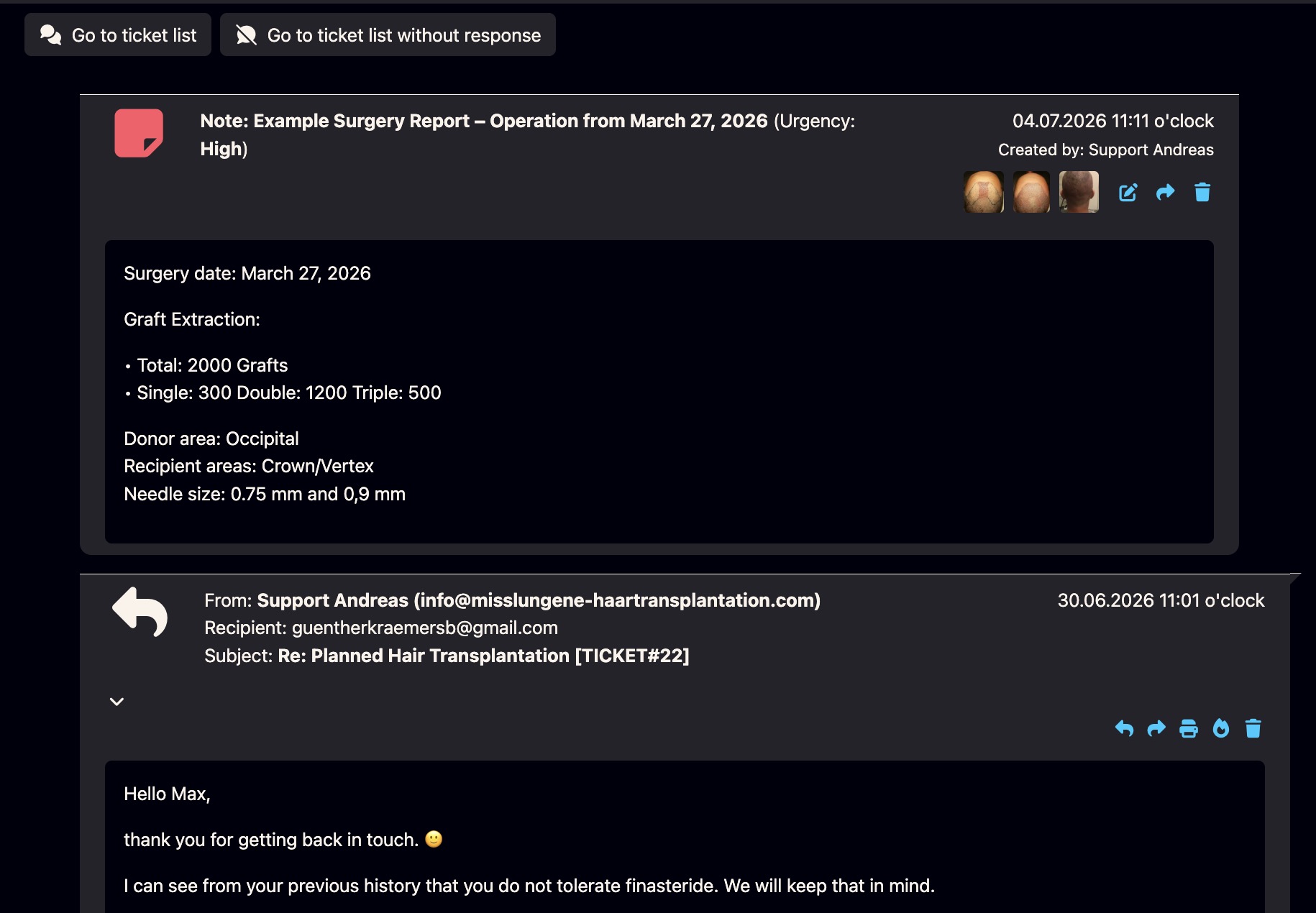
Bodo represents the final stage of professional communication evolution. It integrates a sophisticated AI email editor for teams directly into a robust ticketing system. This integration ensures that every draft is informed by the firm’s collective intelligence and historical data. The system is built on a “One Client, One Ticket” philosophy. This structure is vital for clinics and agencies. It ensures that no detail is lost during transitions between team members. Each interaction is documented. Every decision is traceable. This creates a state of total continuity that fragmented email chains can never achieve.
Security and reliability are the foundations of this platform. Bodo operates on a Swiss-hosted, GDPR-compliant infrastructure. This provides total data peace of mind for organizations handling sensitive client information. Beyond the communication tools, the system includes specialized features for surgery documentation and image management. It’s not just an editor. It’s a comprehensive ecosystem for specialized professionals. By centralizing these functions, Bodo provides a level of structural integrity that simplifies complex administrative challenges.
A premium solution for discerning professionals
Getting started with AI-driven ticketing
The transition from fragmented emails to a state of total integration is a strategic necessity in today’s professional landscape. For many Swiss clinics and agencies, Bodo serves as the preferred Zendesk alternative for clinics. It replaces generic complexity with industry-specific clarity. It provides the disciplined strategy needed to scale operations without losing the calm, authoritative voice that clients expect. This is the movement from a state of complication to one of absolute unity. Elevate your team’s communication today with Bodo’s AI-powered shared inbox. Experience the precision of a system engineered for the highest professional standards.
Achieving Communication Continuity
The integration of an AI email editor for teams is more than a technological upgrade. It is a commitment to organizational order. By centralizing correspondence and leveraging shared intelligence, firms can eliminate the fragmentation that often compromises client trust. You’ve seen how automated summaries and voice-to-email workflows reduce operational friction while maintaining a sophisticated professional register.
Precision is non-negotiable in high-stakes environments. A human-in-the-loop strategy ensures that while machine intelligence handles the heavy lifting, your experts retain final authority. This balance protects your firm’s history and reinforces the stability that discerning clients expect. Our Swiss-hosted and GDPR-compliant infrastructure provides the security your organization demands. With a specialized one-client-one-ticket architecture, we ensure that clinics and professional services never lose sight of a single detail.
Streamline your team communication with Bodo’s AI-powered ticketing system.
Take the next step toward a future of total integration and quiet confidence.
Frequently Asked Questions
Is an AI email editor secure for medical clinics?
Security is guaranteed through Swiss-hosted, GDPR-compliant infrastructure designed specifically for high-stakes environments. Medical clinics rely on advanced encryption and strict data processing standards that protect sensitive patient information. This level of structural integrity ensures that your communication remains private and professional. By centralizing data within a secure shared workspace, you eliminate the risks associated with fragmented, non-compliant personal inboxes.
Can an AI email editor really match our specific brand voice?
A specialized AI email editor for teams achieves brand consistency by allowing you to define a specific professional register. You don’t rely on generic algorithms. Instead, you feed the system your firm’s established guidelines and technical vocabulary. This ensures that every response, regardless of the sender, reflects the calm and authoritative tone expected by your clients. It replaces fragmented voices with a single, high-precision communication strategy.
Does using an AI editor mean my team will stop thinking for themselves?
Critical thinking remains at the center of the workflow because the AI serves as a disciplined strategist rather than a replacement. The system operates on the “AI proposes, expert disposes” principle. Your team uses the editor to handle repetitive drafting and summaries, which actually frees their cognitive capacity for complex decision-making. It reduces administrative friction while keeping the human expert in total control of the final professional output.
How does an AI editor for teams differ from ChatGPT?
Unlike standalone tools like ChatGPT, an integrated editor for teams possesses “Shared Memory” and direct CRM connectivity. It understands the specific history of your client relationships and the collective goals of your firm. ChatGPT acts as an isolated assistant; a team-based editor functions as a structural backbone. It provides contextually relevant suggestions based on previous tickets, ensuring continuity that generic AI models simply cannot match.
Will an AI email editor help with GDPR compliance?
Implementing this technology supports GDPR compliance by centralizing all client data and maintaining absolute traceability. Every AI-assisted draft is recorded within a permanent client history, showing exactly who approved and sent the message. This transparency is essential for modern professional standards. By hosting data on Swiss servers, firms ensure they meet the highest global requirements for data protection and organizational accountability.
Can the AI editor handle multiple languages for international clients?
The system provides instant translation that maintains technical accuracy across multiple languages for international clients. You can serve a diverse client base without the need for external translation services or specialized staff for every language. The AI understands the nuances of professional registers in different cultures. This allows your firm to expand its reach while ensuring that the authoritative tone remains consistent across all geographic borders.
Is it difficult to integrate an AI editor into our existing workflow?
Integration is a methodical process that begins with centralizing your correspondence into a shared inbox. This transition doesn’t disrupt your existing workflow; it streamlines it. By connecting multiple professional addresses into one unified view, the editor gains access to the dataset it needs to function effectively. Most organizations find that moving from fragmented emails to a state of total integration is a logical progression toward higher efficiency.
How much time can a team actually save by using an AI email editor?
Research indicates that an AI email editor for teams can save workers an average of 3.5 hours per week on communication tasks. This efficiency gain comes from automated drafting, thread summaries, and faster response times for repetitive inquiries. For a specialized clinic or agency, this cumulative time savings allows the team to focus on high-value client management. It transforms hours of manual drafting into a high-precision, automated operation.